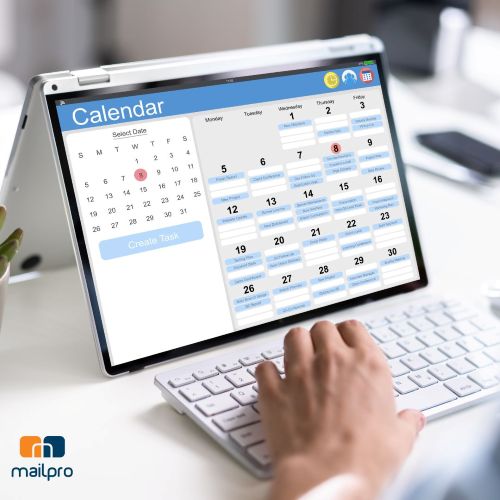
If your email schedule swings between “three sends this week” and “radio silence for a month,” you don’t have a content problem—you have a cadence problem. A good emailing calendar does two things at once: it keeps you visible without burning people out, and it gives your team enough lead time to produce quality work. Below you’ll find simple, copy-paste cadences for B2B and B2C, plus seasonal pivots and the production rhythm that keeps everything moving.
Why a calendar beats “we’ll see”
Sending when inspiration strikes feels flexible… until you’re late for a product launch, you miss a holiday that mattered to your segment, or you burn through your list with back-to-back promos. A calendar forces a few healthy constraints: one owner per send, a clear goal for each message, and a predictable drumbeat your audience can get used to. It also creates space for testing, so results improve over time instead of bouncing around.
First, set your ceiling
Every list has a tolerance level. Most B2B audiences do well with 1–2 emails per week. Many B2C audiences can handle 2–3 when the value is clear (offers, drops, events). If you’re not sure, start lower and earn your way up. Watch complaints and unsubscribes: if they spike, scale back or rebalance message types (more content, fewer promos).
A simple B2B cadence (steady, useful, sustainable)
B2B email works best when it feels like a helpful colleague, not a megaphone. Think education first, promotion second, and anchor your month around a handful of repeatable “shows.”
Month at a glance (example):
-
Week 1
- Tuesday: Educational newsletter (how-to, use cases, one strong CTA to a resource).
- Thursday: Nurture follow-up for active evaluators (case study or comparison guide).
- Week 2
- Wednesday: Product update or feature spotlight (short, benefit-led, link to docs).
- Tuesday: Thought-leadership piece or webinar invite.
- Friday: Customer story snippet with a soft CTA to talk to sales or try a feature.
- Wednesday: “Value recap” email (top content this month, product tips, upcoming events).
- Week 3
- Week 4
Keep it calm on Fridays for B2B unless you know your audience engages then. Slot in lifecycle/triggered journeys (welcome, onboarding, expansion) that run automatically alongside this baseline.
How it feels to the reader: one helpful newsletter, one product-ish note, one event/learning moment, and one recap—enough to stay top-of-mind without crowding the inbox.
A simple B2C cadence (dynamic, seasonal, still respectful)
B2C thrives on rhythm and momentum. You’ll mix content that inspires with offers that convert, then layer seasonal bursts when it matters.
Month at a glance (example):
-
Week 1
- Monday: “What’s new” newsletter (editor’s picks, trends, inspiration).
- Thursday: Light promo or category highlight.
- Week 2
- Tuesday: Social-proof story (UGC, ratings, before/after) + soft offer.
- Monday: Promotion with clear end date; remind only once.
- Saturday: Weekend mini-drop (limited quantity, localized if needed).
- Wednesday: Content or how-to (care tips, recipes, style guides).
- Friday: Back-in-stock or “most-loved” roundup.
- Week 3
- Week 4
When a seasonal moment hits—Mother’s Day, back-to-school, Black Friday—compress this cadence for 7–10 days and make the value obvious. Outside peak periods, keep the balance humane.
How it feels to the reader: useful content they’d share, a couple of timely offers, and moments of genuine excitement—without daily noise.
Seasonal pivots without chaos
- B2B: Build around your industry calendar (events, fiscal year, product cycles). Your “event month” might swap the recap for a multi-touch webinar sequence. Your Q4 might emphasize renewals and ROI stories.
- B2C: Anchor spring, summer, back-to-school, and holiday. Plan one “hero” story per season, then feed it with product picks, tips, and two clean promotional windows.
Production rhythm that keeps you on time
A calendar isn’t just dates—it’s the cadence your team follows to make those dates real.
- Thursday (for the following week): lock topics, owners, and the single KPI per send.
- Monday: copy draft ready by noon; design starts after copy, not before.
- Tuesday: build and segmentation; add UTMs once; set up tests (subject or hero).
- Wednesday: QA in a fixed order (from/reply-to, subject + preheader, links/UTMs, images + ALT, accessibility, mobile/dark-mode, segments/suppressions, legal).
- Thursday: approvals; schedule.
- Send day: monitor the first hour—bounces and complaints tell you if anything’s off.
This rhythm works for both B2B and B2C; only the content changes.
Planning your themes (so the calendar never runs dry)
Pick 3–5 pillars you can speak about forever, then rotate.
- B2B pillars: problems you solve, customer outcomes, product education, industry perspective, integrations.
- B2C pillars: newness/drops, social proof, how-to/use, lifestyle/occasions, value/offer.
Brainstorm five ideas under each pillar once per quarter. That’s your idea bank. When a week opens, you pull from the bank instead of staring at a blank page.
Testing without derailing the schedule
Treat tests like seasoning—present in every meal, but never the whole thing. One test per send is enough: subject line pairs, hero copy, or CTA phrasing. Log what won, by how much, and what you’ll try next. Over a quarter, the compounding gains are real.
Signs your cadence is right (and when to dial it back)
It’s working if opens are stable, click-throughs are steady or improving, and complaint rates stay under 0.1%. It’s too much if unsubscribes spike, clicks fall while sends rise, or you need more reminders to hit the same revenue. In that case, reduce frequency or rebalance toward content and lifecycle messages.
Putting it into Mailpro (so the plan sticks)
- Templates & Builder: save layouts for each “show” (newsletter, promo, webinar). Reuse blocks; edit copy, not structure.
- Segmentation: send the right cadence to the right people—active vs. dormant, buyers vs. browsers, regions and languages.
- Anti-Spam Check: quick pre-flight before anything goes live.
- Campaign Statistics: review by domain and segment; your Gmail and Outlook audiences don’t always behave the same.
- Forms & SMS: pair key moments with short forms (webinar sign-ups, preference updates) and use SMS for time-sensitive reminders.
Two fill-in calendars you can copy
B2B (4-week cycle)
Week 1 Tue: Newsletter (how-to).
Week 1 Thu: Evaluator nurture (case study).
Week 2 Wed: Feature spotlight.
Week 3 Tue: Webinar invite or POV article.
Week 3 Fri: Customer story.
Week 4 Wed: Monthly value recap.
B2C (4-week cycle)
Week 1 Mon: New & noteworthy.
Week 1 Thu: Light promo.
Week 2 Tue: Social proof.
Week 3 Mon: Timed promotion.
Week 3 Sat: Weekend mini-drop.
Week 4 Wed: How-to or style guide.
Week 4 Fri: Back-in-stock / most-loved.
Start here, then tune it to your audience and resources. The goal isn’t to send more—it’s to send with purpose. When your calendar, your process, and your tools line up, you’ll feel the difference: calmer production, clearer results, and subscribers who actually look forward to hearing from you.
Related guides: email marketing goals for 2026 · holiday email mistakes to avoid · email list building ideas