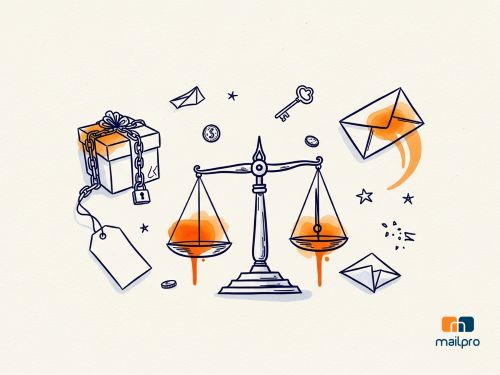
"Free" is one of the most misused words in email marketing. Search "free newsletter software" and you'll find dozens of tools that are technically free — but almost all of them carry limits that quietly become expensive the moment your list starts growing.
This article is an honest look at what free newsletter software actually offers, where the catches hide, and when it's smarter to skip free plans entirely and go straight to affordable pay-as-you-go alternatives.
For the bigger picture on the category, see our complete guide to newsletter software.
"Free" Usually Means Freemium
Almost every "free" newsletter tool is freemium: a free tier designed to get you started, with paid tiers that unlock the features you'll need once you're serious. That's not a bad thing — freemium is a fair way to try software before you buy. The problem is that the marketing copy rarely spells out what you're giving up.
A typical free plan includes:
- A cap on contacts (often 500–1,000)
- A cap on monthly sends (often 1,000–3,000)
- Basic templates only
- Vendor branding in every email ("Powered by…")
- No or limited automation
- No A/B testing
- Community support only — no human help
- Restricted analytics (no heatmaps, no comparisons)
What You Actually Get on a Free Plan
Here's an honest read on the most common free plans in 2026.
Generous Free Plans
- MailerLite: Free up to 1,000 contacts and 12,000 emails/month. Solid editor. Forced branding on paid low tier removed at higher plans.
- Brevo: Unlimited contacts, 300 emails/day on free. Branding included. SMS costs extra.
Tighter Free Plans
- Mailchimp: Up to 500 contacts, 1,000 sends/month. Branding, limited templates, very basic automations.
- HubSpot Marketing Free: Up to 2,000 sends/month with HubSpot branding. Good for CRM integration, heavier for pure newsletter senders.
The Real Cost of "Free"
Free plans cost you in five quiet ways:
1. Branding in Every Email
Your newsletters carry the vendor's logo at the bottom. For a hobbyist, fine. For a business, it signals "small and unpolished" to every subscriber.
2. Deliverability Trade-Offs
Free plans often share sending infrastructure with every other free user — including the spammy ones. Your emails inherit the neighborhood's reputation. Paid plans get better infrastructure, better authentication support, and higher inbox placement.
3. No Real Support
When an email campaign goes sideways at 4pm on a Friday, "community forum" is not the answer you want. Free plans almost never include human support.
4. Feature Paywalls for Essentials
Segmentation, A/B testing, automations, multi-user access, and even removing vendor branding are frequently gated behind paid tiers. You'll hit the wall fast.
5. Forced Upgrades as You Grow
Per-contact free plans are built to push you into a paid plan the second you cross the threshold — and that paid plan is usually one of the more expensive per-contact options on the market. A free plan that sets you up for an expensive paid plan isn't really free.
When Free Newsletter Software Is Good Enough
Free tiers make sense in three specific situations:
Want a genuinely free start? Mailpro’s plans let you begin at no cost and upgrade only when you grow — no ads stamped on your emails.
- Hobby projects or personal newsletters. Under 500 subscribers, no revenue attached, branding doesn't matter.
- Temporary testing. You want to kick the tires on a product before committing money.
- Ultra-small nonprofits. A handful of supporters, monthly updates, no budget yet (though we'd still argue pay-as-you-go is cheaper long-term — see newsletter software for nonprofits).
When It's Time to Stop Using Free Software
If any of these are true, stay on a free plan is costing you money:
- Your list is over 500 active contacts
- You send more than one campaign per week
- Newsletters generate actual revenue
- You want to remove vendor branding for credibility
- You need A/B testing, segmentation, or welcome automations
- You have European customers and need a stronger privacy posture (see GDPR-compliant newsletter software)
The Smarter Alternative: Pay-As-You-Go
If free plans feel limiting and per-contact subscriptions feel expensive, there's a third path most buyers miss: pay-as-you-go. Instead of a monthly fee, you buy email credits and spend them as you send.
For a small business sending a weekly newsletter to 1,000–2,000 contacts, pay-as-you-go often costs less per month than an upgraded freemium tier — with no forced branding, no send caps, no surprise upgrades, and full deliverability infrastructure.
Mailpro uses this model. See the pricing — you pay for what you send and nothing else, get the full feature set (no paywalled essentials), and your data is Swiss-hosted and GDPR compliant from day one.
Full breakdown in our newsletter software pricing guide.
Comparing Free Plans vs. Pay-As-You-Go at Small Scale
A quick head-to-head for a business with 1,500 contacts sending a weekly newsletter (6 sends/month × 1,500 = ~9,000 emails/month):
- Popular free plans: You'll exceed the contact limit and usually the send limit. The upgrade lands you on a per-contact plan at $20–$40/month — with vendor branding often still present at the lowest paid tier.
- Pay-as-you-go (Mailpro): Around €20–€30/month at that volume — full feature set, no branding, Swiss hosting.
For most businesses that are past the hobbyist stage, pay-as-you-go ends up both cheaper and more professional.
Mistakes to Avoid With Free Newsletter Software
- Treating "free forever" as a strategy. It's a starting point, not a destination.
- Ignoring migration cost. Moving lists, templates, and automations later is painful. Pick a vendor you could imagine staying with paid.
- Sending from a free plan to cold contacts. Free-tier deliverability is already fragile; don't make it worse.
- Building on paywalled features. If your workflow depends on A/B testing or automations, a free plan without them is a dead end.
- Overlooking privacy. Free plans tend to have weaker contractual protections. If you process EU data, start compliant.
Start Free Without the Trade-Offs
You can create a free Mailpro account in under two minutes, explore the full product, and only spend credits when you actually send. No forced branding, no paywalled essentials, no per-contact math. When you're ready to scale, the pricing page shows exactly what each volume tier costs.
Related reads:
Comparing tools? See our guide to the best email marketing services of 2026, with prices.
Mailpro and free email tools
Start free — and only pay when you’re ready to grow
"Free" often means crippled or ad-stamped. Mailpro lets you start without paying, keep your own branding, and move to a fair plan only when your list outgrows the free tier.