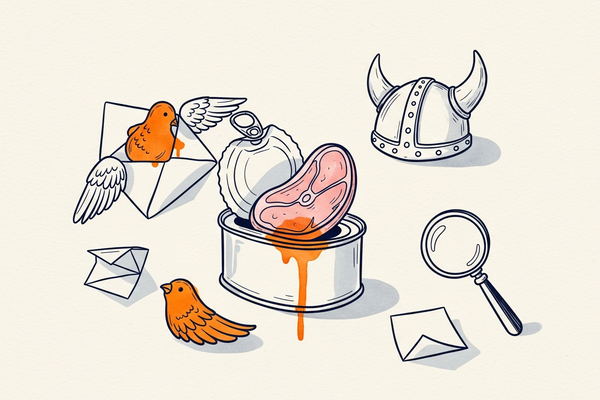
You delete it every day. You've trained your thumb to swipe it away without even reading the sender. But have you ever stopped to wonder why we call unwanted email "spam" in the first place — and not, say, "junk," "garbage," or "Brian"? The answer involves a tin of pork shoulder from 1937, a troupe of British comedians, a chorus of singing Vikings, and a marketer in 1978 who is still, to this day, deeply unapologetic. Grab a coffee. This one's fun.
It started with a can of meat
In 1937, the Hormel Foods company launched a tinned, pre-cooked pork product called SPAM. The name (possibly a mashup of "spiced ham," though Hormel has always been coy about it) became a household staple, especially during the Second World War when it was shipped to soldiers by the millions of cans. SPAM was everywhere. It was cheap, it was inescapable, and it turned up at every single meal whether you wanted it or not.
Hold on to that last part — everywhere, inescapable, whether you wanted it or not. That's the bit that matters.
Then came the Vikings
Fast-forward to 1970. The British comedy group Monty Python aired a now-legendary sketch set in a greasy café where every item on the menu contains Spam. "Spam, eggs, sausage and Spam." "Spam, Spam, Spam, egg and Spam." A customer pleads for something — anything — without Spam, and is essentially told tough luck. Meanwhile, a group of horned Vikings in the corner begin chanting "Spam, Spam, lovely Spam, wonderful Spam" louder and louder until the word completely drowns out the actual conversation.
And there it is. A meaningless flood of the same word, repeated endlessly, burying anything useful underneath it. Sound familiar?
How the meat became the metaphor
In the 1980s and early 1990s, as people gathered in early online communities — chat rooms, bulletin boards, Usenet groups — a familiar problem appeared. Someone would flood a discussion with the same message over and over, drowning out the real conversation. The geeks of the era, raised on Monty Python, reached for the obvious word: they were spamming the channel.
The name stuck because it was perfect. Just like the sketch, spam is repetitive, unwanted, and impossible to escape — it buries the messages you actually care about. By the time unsolicited bulk email became a plague in the late 1990s, "spam" was already the word everyone used. Hormel, to its credit, has been remarkably good-humored about its product becoming a global synonym for digital garbage.
But the very first spam email came earlier — and someone is still proud of it
Here's the twist. The first true spam email predates the word being applied to it. On 3 May 1978, a marketer named Gary Thuerk, who worked for the Digital Equipment Corporation, sent an unsolicited promotional email to roughly 400 people on ARPANET (the early internet) advertising a new line of computers. He didn't have a mailing tool, so he reportedly typed the recipients in by hand until the address field overflowed.
People were furious. It caused a small uproar. And Gary Thuerk — now affectionately (or not) known as the "Father of Spam" — has spent the decades since insisting it was a roaring success, claiming the blast generated something like $13 million in sales. Whether that number is real or marketing folklore, he started something that now accounts for the majority of all email traffic on Earth.
The lesson hiding inside the joke
Want to make sure your emails aren’t treated like the canned stuff? Mailpro’s SMTP keeps your sender reputation clean so you reach the inbox, not the spam folder.
Here's the genuinely useful part, because the story is also a perfect definition of what not to do. Spam earned its name by being three things: unwanted, repetitive, and sent to people who never asked for it. Which means the recipe for not being spam is simply the opposite:
- Get permission. The single biggest line between "marketing" and "spam" is whether the person agreed to hear from you. This is why confirmed, double opt-in subscription matters, and why you should never buy an email list — bought contacts never asked for you, which is the textbook definition of the V-word.
- Be relevant, not repetitive. The Vikings sang one word forever. Don't be the Vikings. Send things people actually want.
- Mind your words. Even legitimate senders get filtered for sounding spammy. It's worth knowing which spam-trigger words to avoid and how Gmail's spam filter thinks.
- Earn your place in the inbox. Modern filters reward senders with good reputation and clean habits. Our deliverability guide and tips on passing anti-spam checks are a good place to start, and a platform with proper anti-spam tooling does a lot of the heavy lifting for you.
For a bit more context on how we got from a 1978 ARPANET blast to the inbox you know today, our short history of email is a fun companion read. And if your perfectly legitimate messages keep landing in the spam folder anyway, that's a problem worth fixing — because being mistaken for a singing Viking is no fun at all.
Send things people are actually glad to get
The whole point of the spam story is that great email marketing is the opposite of spam: wanted, relevant, and sent with permission. Mailpro is built around exactly that — permission-based lists, clean deliverability, and Swiss-grade respect for your subscribers' inboxes. Create your free Mailpro account and send emails people are happy to open, or take a look at the plans to find the right fit.
Frequently asked questions
Why is junk email called spam?
The term comes from a 1970 Monty Python sketch in which the word "Spam" (the canned meat) is repeated endlessly until it drowns out all other conversation. Early internet users adopted "spam" to describe repetitive, unwanted messages that bury real content — and the name stuck for junk email.
What was the first spam email?
It was sent on 3 May 1978 by Gary Thuerk, a marketer at the Digital Equipment Corporation, to around 400 users on ARPANET to advertise computers. It's widely considered the first unsolicited bulk email, earning Thuerk the nickname "Father of Spam."
Is SPAM the meat related to spam email?
Yes, indirectly. The email term descends from the Monty Python sketch, which was itself about the Hormel canned meat product called SPAM, introduced in 1937. The meat came first; the metaphor came later.
How do I keep my emails from being treated as spam?
Only email people who opted in, keep your list clean, avoid spam-trigger wording, and maintain a good sender reputation. Using a dedicated email platform with built-in deliverability and anti-spam features makes this far easier than sending from a regular inbox.
Mailpro and staying out of spam
Know the history — then stay out of the spam folder
The word has a funny origin, but landing in spam isn’t funny for your business. Mailpro’s authenticated SMTP and reputation monitoring keep your real emails out of the junk folder.