
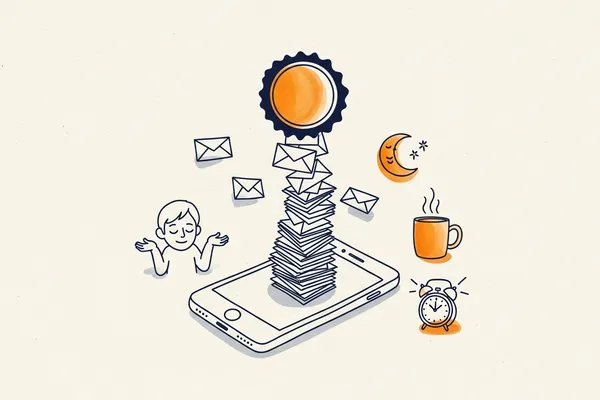
Why you have 12,000 unread emails (and why that's fine)
Somewhere on your phone right now is a little red badge with a number in it. For a lot of people that number has commas. Twelve thousand unread. Forty thousand. A friend of mine crossed one hundred thousand and simply stopped seeing it, the way you stop hearing a fridge hum. If that's you: relax. The giant unread count is not a character flaw. It's a completely rational response to a broken situation, and understanding why says a lot about how email actually works.
The short version
- A huge unread count is normal, not a sign you're disorganised.
- We hoard unread emails because opening one feels like agreeing to do something.
- The badge weaponises a bit of brain wiring called the Zeigarnik effect.
- For anyone who sends email, the lesson is humbling and useful: nobody reads everything.
Two kinds of people, one inbox
Humanity splits cleanly into two camps. There are the inbox-zero people, who feel physical discomfort at a single unread message and file everything into tidy folders. And there are the inbox-infinity people, who treat the inbox as a search bar with a weather system: everything's in there somewhere, and the unread count is just background noise. Neither is wrong. They've simply made peace with email in opposite directions.
Why we let them pile up
The unread count grows for reasons that are surprisingly human:
- Opening an email is a to-do, not a read. Some messages need a decision, a reply, a task. Leaving them unread is a way of saying "not now" without admitting you'll probably never get to it.
- The badge exploits your brain. Psychologists call it the Zeigarnik effect: we remember and fixate on unfinished tasks more than finished ones. That red number is a machine for manufacturing low-grade guilt.
- Decision fatigue is real. Every message is a tiny choice, archive, reply, delete, ignore. Multiply by a few hundred a day and the brain quite sensibly gives up and lets them stack.
- Most of it doesn't matter. Deep down you know 95% of the pile is receipts, newsletters, and notifications. So the cost of ignoring it feels, correctly, very low.
Should you actually care?
Mostly, no. If the unread count causes you genuine anxiety, there's a liberating move: declare email bankruptcy. Select all, mark as read, and start from today. Nothing important will actually vanish, and if it's truly urgent, it'll come back. The people who feel best about their inboxes aren't the ones who read everything, they're the ones who decided not to feel guilty about the rest.
Sending too often is a fast way to become part of someone's unread pile. Our take on email fatigue explains how to avoid it.
What this means if you send email
Here's where inbox guilt gets useful. If you run a newsletter or send marketing email, that ocean of unread messages is the water you're swimming in. A few hard truths follow:
- Nobody reads everything, including your stuff. Your open rate isn't low because your writing is bad; it's competing with twelve thousand other unreads. Plan for it.
- The subject line is the whole game. In a wall of unread, the subject and sender name are often all anyone sees. That's the entire decision.
- Sending more is not sending better. Every extra email raises your odds of becoming background noise, or worse, the reason someone finally hits unsubscribe. Fewer, better emails win.
- Let inactive people go. Contacts who never open aren't just harmless clutter, they drag your deliverability down. Sunsetting them is a kindness to everyone, including your sender reputation.
The 12,000 unread emails aren't a problem to be solved. They're a reminder: attention is scarce, permission is precious, and the sender who respects both is the one who gets read.
Frequently asked questions
Is it bad to have thousands of unread emails?
No. A large unread count is normal and mostly harmless, the vast majority is receipts, newsletters and notifications. It reflects how you triage, not how organised or capable you are.
What is the Zeigarnik effect?
It's the psychological tendency to remember and fixate on unfinished tasks more than completed ones. An unread badge taps directly into it, which is why that little red number nags at you.
What does "declaring email bankruptcy" mean?
Marking your entire backlog as read (or archived) and starting fresh from today. Genuinely important messages tend to resurface, and you lose the guilt of a bottomless backlog.
As a sender, how do I avoid the unread pile?
Send less but better, write subject lines that earn the open, and remove people who never engage. Relevance and restraint beat volume every time.
Mailpro and engagement
Be the email that gets opened, not ignored
Clear stats, easy segmentation and a spam check help you send fewer, sharper emails people actually want. Swiss-hosted, GDPR-native, since 2001.