
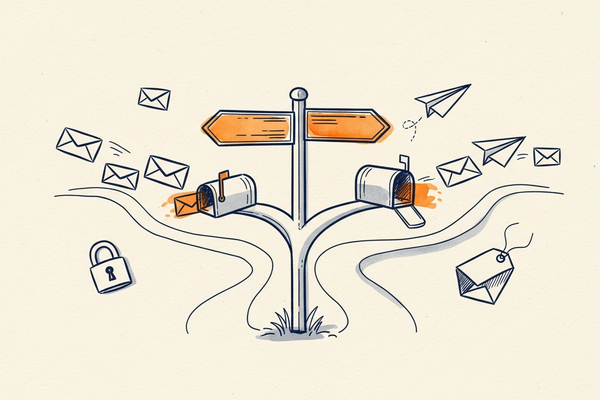
What is a sending subdomain?
A sending subdomain is a subdomain of your main domain — for example news.yourbrand.com or mailer.yourbrand.com — that you use as the "From" domain for a specific stream of email. Instead of sending everything from your root domain (yourbrand.com), you route different kinds of mail through different subdomains so each one builds its own sender reputation. The most important split is separating your marketing email from your transactional email, so a bad newsletter week can never drag down the password resets and receipts your customers actually need.
Mailbox providers like Gmail, Outlook and Yahoo track reputation largely at the domain level. When marketing and transactional mail share one domain, they share one reputation — and the high-volume, lower-engagement marketing stream is usually the one that gets you filtered. A subdomain strategy walls off that risk.
Key takeaways
- A sending subdomain is a dedicated "From" domain for one email stream, built on top of your root domain.
- Splitting marketing and transactional email onto separate subdomains gives each its own reputation.
- Transactional mail (receipts, resets, alerts) is high-trust and must reach the inbox — isolate it from promotional risk.
- Each subdomain needs its own SPF, DKIM and DMARC alignment to be trusted.
- Keep your root domain clean: many senders never send bulk mail from the root at all.
Why split marketing and transactional email onto separate subdomains?
You split them because the two streams have opposite risk profiles, and sharing a reputation lets the risky one damage the critical one. Marketing email goes to large lists, gets lower engagement, and draws the occasional spam complaint — all signals that pull reputation down. Transactional email goes to people who just asked for it (a receipt, a shipping update, a transactional email like a password reset), so it earns high engagement and almost no complaints.
If both ride the same domain, a bad promotional send — a rented list, a spike in complaints, a spam-trap hit — degrades the shared reputation and your transactional mail starts landing in spam too. That is the worst possible outcome: the customer who reset their password never gets the email, files a support ticket, and loses trust. Separating streams means a marketing problem stays a marketing problem and never touches the mail your business depends on.
The same logic scales further: high-volume senders often run three or more subdomains — one for newsletters, one for transactional, one for cold or re-engagement mail — so each reputation is isolated and diagnosable. When something goes wrong, you know exactly which stream to fix.
What's the difference between your root domain and a sending subdomain?
Your root domain is your primary identity (yourbrand.com) — the one on your website and your corporate email. A sending subdomain is a child of it (mailer.yourbrand.com) that you delegate specifically to bulk or automated sending. They are related in DNS, but mailbox providers can build a separate reputation for each, which is the entire point.
The practical reason not to blast marketing from your root domain: your root also carries your employees' day-to-day email. If promotional sending harms the root's reputation, your sales reps' one-to-one emails start hitting spam too. Sending from a subdomain keeps human, conversational mail on the clean root and pushes bulk risk onto a domain built for it.
What subdomains should you set up?
Set up one subdomain per distinct email stream, named clearly so both mailbox providers and your own team can tell them apart. There is no magic in the exact words — pick short, readable labels and stay consistent. A common starting layout:
| Stream | Example subdomain | Typical mail |
| Marketing | news.yourbrand.com | Newsletters, promotions, campaigns |
| Transactional | mailer.yourbrand.com | Receipts, password resets, shipping, alerts |
| Re-engagement / cold | connect.yourbrand.com | Win-back, prospecting, reactivation |
| Corporate (root) | yourbrand.com | One-to-one human email only |
Most small and mid-size senders only need the first two — marketing and transactional — and leave the root for human mail. Add a third stream only when you genuinely send cold or re-engagement mail whose risk you want quarantined from the rest.
How do you set up sending subdomains step by step?
Set up a sending subdomain in five steps: pick the name, create the DNS records, authenticate it, warm it up, and route the right stream to it. Here is the practical sequence.
- Choose the subdomain names. Decide your streams (at minimum marketing and transactional) and pick a short label for each. Keep them human-readable, not random strings.
- Create the DNS records. In your DNS, publish the records your sending platform gives you for that subdomain — typically a CNAME or MX plus the authentication records below. Each subdomain is configured independently.
- Authenticate each subdomain. Publish SPF, DKIM and DMARC so the subdomain aligns and is trusted. Authentication is per-subdomain — a DKIM key on your root does not automatically cover mailer.yourbrand.com. Getting this right is the foundation of email deliverability.
- Warm up the new subdomain. A brand-new subdomain has no reputation, so ramp volume gradually — start with your most engaged contacts and increase over days or weeks. Because IP and domain reputation are built on recent sending history, a cold subdomain sent at full volume looks suspicious.
- Route each stream to its subdomain. Configure your marketing tool to send from the marketing subdomain and your app or transactional system to send from the transactional one. From here the two reputations grow independently.
Done properly, this gives you clean, separately measurable reputations — and when one stream dips, the fix is isolated instead of global.
Want the sending side handled for you? With Mailpro's SMTP relay you can send each stream from its own authenticated subdomain without managing your own mail server.
How does subdomain separation protect transactional deliverability?
It protects transactional deliverability by keeping the reputation signals that decide inbox placement separate for each stream. Mailbox providers weigh recent engagement, complaint rate and spam-trap hits per sending domain. Because transactional mail is expected, opened and rarely reported, its subdomain earns and keeps a strong reputation — which means resets, receipts and alerts reliably reach the inbox.
Crucially, that strong transactional reputation is now immune to your marketing swings. A promotional campaign that triggers complaints hurts only the marketing subdomain; the transactional subdomain, and the mail your customers are waiting for, stays untouched. This is why splitting streams is one of the highest-leverage moves you can make to improve email deliverability where it matters most.
Do sending subdomains share reputation with the root domain?
Mostly no — that separation is the benefit — but the relationship is not perfectly airtight. Mailbox providers build a distinct reputation for each subdomain, so day-to-day, news.yourbrand.com and mailer.yourbrand.com are judged on their own behaviour. That is exactly why the split works.
However, the root domain's reputation can still influence how a brand-new subdomain is initially treated, and severe problems (like the root landing on a blocklist) can spill over. The takeaways: keep your root clean, authenticate every subdomain properly, and don't treat subdomains as disposable throwaways — a burned subdomain still reflects on your brand. If you also send from a dedicated IP, weigh the trade-offs in our guide to the pros and cons of a dedicated IP.
Sending subdomain best practices and mistakes to avoid
The biggest mistake is sending everything from the root domain and only discovering the problem when transactional mail starts failing; the second is spinning up subdomains without authenticating them. Keep these principles in mind:
- Never mix streams. One subdomain, one purpose — don't send promotions from your transactional subdomain "just this once".
- Authenticate every subdomain. SPF, DKIM and DMARC alignment is per-subdomain, not inherited from the root.
- Warm up before you scale. A new subdomain has zero reputation; ramp volume gradually with engaged contacts first.
- Protect the root. Reserve it for human, one-to-one mail so bulk risk never touches your team's email.
- Stay consistent. Don't rotate subdomain names to dodge filters — that pattern looks like a spammer and destroys the reputation you're building.
- Monitor each stream separately. Track deliverability, complaints and bounces per subdomain so a dip is easy to isolate and fix.
Frequently asked questions
Do I need a separate subdomain for transactional email?
If transactional mail matters to your business — and it almost always does — yes. Isolating it on its own subdomain protects receipts, password resets and alerts from any reputation damage caused by your marketing campaigns, so the mail customers are waiting for keeps reaching the inbox.
Can I just use my root domain for everything?
You can, but it's risky. Everything then shares one reputation, so a bad marketing send can push your transactional mail — and even your employees' one-to-one email — into spam. Most senders reserve the root for human mail and send bulk from subdomains.
Does each subdomain need its own SPF and DKIM?
Yes. SPF, DKIM and DMARC alignment is evaluated per sending domain, so each subdomain needs its own records. A DKIM key or SPF record on your root does not automatically authenticate a subdomain.
How many sending subdomains should I have?
Start with two — marketing and transactional — and keep the root for human mail. Add a third (for cold or re-engagement mail) only if you genuinely send that stream and want its risk quarantined from the rest.
Do subdomains share reputation with my main domain?
Largely no — mailbox providers score each subdomain separately, which is the whole point. But the root can influence a new subdomain's initial treatment, and severe root problems can spill over, so keep the root clean and authenticate every subdomain.
Do I need to warm up a new sending subdomain?
Yes. A brand-new subdomain has no sending history, so ramp volume gradually — start with your most engaged contacts and increase over days or weeks — otherwise providers may treat a sudden full-volume send as suspicious.
Can Mailpro send from my own subdomain?
Yes. With Mailpro you can authenticate and send each stream from its own subdomain — marketing from one, transactional via SMTP from another — so each builds an independent, protected reputation.
Mailpro and deliverability
Send every stream from its own protected subdomain
Authenticate your marketing and transactional subdomains, send via SMTP, and keep each reputation clean. Mailpro is Swiss-hosted, GDPR-native, and priced by emails sent, not list size.