
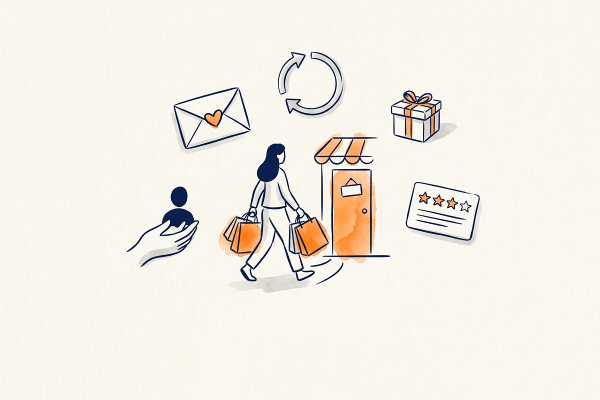
How do you turn holiday shoppers into repeat customers?
You turn holiday shoppers into repeat customers with a post-purchase email sequence built for first-time buyers: thank them and set expectations, keep them informed until the parcel arrives, help them use (or gift) what they bought, ask for a review at the right moment, invite gift recipients to join your list themselves, and make a second-purchase offer in January, once the holiday noise has died down. Most stores send the order and shipping confirmations, then nothing until the next sale. That silence is why so many Black Friday customers never order twice.
This guide gives you the full sequence with timings for Black Friday (27 November 2026), Cyber Monday (30 November) and December orders, ready-to-adapt subject lines, three store examples, and the one metric that tells you whether it worked: the repeat purchase rate of your holiday cohort.
Key takeaways
- A holiday first-time buyer needs a different follow-up than a regular customer: they don't know your brand yet, and much of what they buy in December is a gift for someone else.
- Split the sequence early into “bought for myself” and “bought as a gift”. The how-to email, the review request and the second offer all change depending on who ended up with the product.
- Don't send the second-purchase offer in December. Mid-January, 45 to 60 days after a Black Friday order, is when the return window has closed and buyers are ready to shop for themselves again.
- Gift recipients are the most overlooked new audience of the season. You can't email them from the shipping address, but a card in the parcel with a sign-up form can bring them in with their own consent.
- Measure the repeat purchase rate of the holiday cohort at 90 days, not total email revenue, to know whether the sequence is working.
Why do holiday first-time buyers rarely buy again?
Holiday first-time buyers rarely buy again because they were brought in by a discount or a gift need, not by the brand. Once the parcel is delivered, nothing ties them to the store, and their inbox is flooded with offers from every other shop until early January.
Three things make the holiday cohort harder to keep than customers acquired the rest of the year:
- Promotion-driven intent. Many came for a Black Friday price. Cohorts acquired with a deep discount tend to repeat less than full-price buyers, so the follow-up has to give them another reason to come back.
- The product often leaves the house. If the order was a gift, the buyer never uses it. Product tips and review requests sent to the buyer then miss the mark.
- Timing collisions. December is the noisiest month in the inbox, and January is when people control their spending. An offer sent at the wrong moment is ignored or, worse, triggers an unsubscribe.
A post-purchase sequence designed for this cohort fixes all three. It complements the general store flows described in our guide to email marketing for ecommerce, which covers welcome, cart and win-back flows for the whole year; here the focus is only on the weeks after a first holiday order.
What should a holiday post-purchase email sequence include?
A holiday post-purchase email sequence should include six to eight emails over roughly 60 days, from the order confirmation in late November to a second-purchase offer in mid-January. The table below gives the timing for an order placed on Black Friday, 27 November 2026.
| # | When to send | Black Friday order | Goal | |
|---|---|---|---|---|
| 1 | Order thanks and confirmation | Immediately | 27 Nov | Reassure, set delivery expectations |
| 2 | Shipping and delivery updates | When the parcel ships, then on delivery | 30 Nov to 4 Dec | Prevent “where is my order?” anxiety |
| 3a | How-to and onboarding (bought for themselves) | 2 days after delivery | around 6 Dec | Help them get value fast |
| 3b | Gift-ready email (bought as a gift) | On delivery | around 4 Dec | Gift receipt, wrapping, a guide to slip in the box |
| 4 | Review request | 7 days after delivery (self) or 27 Dec (gift) | around 11 Dec or 27 Dec | Collect social proof and feedback |
| 5 | Season's thank-you, no sales pitch | Between 28 and 30 Dec | 28 to 30 Dec | Build goodwill before January |
| 6 | Second-purchase offer | 45 to 60 days after the order | 12 to 26 Jan | Turn the first order into a second one |
| 7 | Offer reminder | 4 to 5 days later | 16 to 30 Jan | Catch those who opened but didn't buy |
For orders placed later, shift every step by the same delay, but keep the anchors that depend on the calendar: the gift review request after Christmas and the second offer no earlier than the second week of January. A customer who bought on 18 December gets a shorter sequence, not a squeezed one.
1. The order thanks email: welcome a new customer, not just an order
The order confirmation is the most opened email a store sends: Omnisend's 2026 ecommerce benchmarks put its open rate at around 54%. For a first-time buyer, use that attention for three things beyond the order summary: a one-line welcome (“This is your first order with us, thank you for trying us”), a realistic delivery date with the holiday shipping cut-off, and a simple way to mark the order as a gift if the checkout didn't ask.
That last point matters for everything that follows. A “Was this a gift? Tell us in one click” button, which adds a tag to the contact, is what lets you split the sequence into the self and gift branches.
2. Shipping and delivery updates: fewer support tickets, more trust
In peak season, carriers slow down and customers check their order several times before it arrives. Send an email when the parcel ships with the tracking link and the updated delivery estimate, and a short one on delivery. Mention the holiday return window here too. If you extend returns to a date in January, say so: it lowers purchase anxiety and makes the gift-giver more relaxed about the choice.
3. How-to and onboarding, or the gift-ready email
The third email is where the two branches part:
- Bought for themselves: send a short how-to two days after delivery. Care instructions for a sweater, three recipes for a coffee grinder, setup tips for a gadget, or a 60-second video. The aim is a good first experience, which is what makes a second order possible.
- Bought as a gift: send a gift-ready email on delivery. Include a printable gift receipt, wrapping or presentation ideas, and a one-page guide the buyer can slip into the box. That guide is also where you invite the recipient to join your list (see step 5 below).
4. The review request: time it to who uses the product
Ask for a review when the person has actually used the product. For self-buyers, that is about seven days after delivery, or three to four weeks for products that need time, such as skincare or supplements. For gift buyers, wait until 27 December and change the question: ask how the gift was received and how the buying experience went, not how the product performs. A short survey works well here, and the answers tell you why first-time buyers chose you. Our guide to the customer satisfaction survey covers the questions to ask.
5. Gift-recipient capture: grow your list with the people who received your products
Gift recipients are new customers in waiting: they hold your product, but you don't have their email address, and you may not use one the buyer typed for delivery to send them marketing. In the EU, the UK and most other markets, a recipient can only be added to your list with their own consent.
The way to reach them is through the parcel. Add a small card or the gift guide from step 3 with a QR code that leads to a sign-up form, and give a reason to sign up: a care guide, an exchange made easy, or a welcome offer valid from January. An embedded form built with Mailpro's online forms for ecommerce collects the address with consent, tags the contact as “gift recipient”, and can start a dedicated welcome sequence. Our guide on how to create the welcome email shows what that first message should contain.
6. The season's thank-you: one email with nothing to sell
Between Christmas and New Year, send all holiday first-time buyers a short, personal thank-you from the founder or the team: what the season meant for the shop, a behind-the-scenes photo, a reminder of the return deadline. No discount, no product grid. It is the email that makes the January offer feel like the next step in a relationship instead of one more promotion.
Each step of this sequence can run on its own once a holiday order arrives. See how automated emails work in Mailpro™
When should you send the second-purchase offer to holiday buyers?
Send the second-purchase offer to holiday buyers in mid-January, 45 to 60 days after their first order, and no earlier than the second week of January. For a Black Friday or Cyber Monday order, that means between 12 and 26 January 2027.
December is the wrong moment for three reasons: buyers are still spending on other people, a new discount days after their purchase makes them feel they overpaid, and some orders will still be returned. By mid-January, the return windows have closed (the EU's 14-day withdrawal period from delivery, plus any extended holiday policy), people are shopping for themselves again, and your offer competes with fewer holiday promotions.
What to offer depends on the branch:
- Self-buyers: a product that complements the first one (a refill, an accessory, the next size up), or free shipping on a second order. Keep the offer time-limited, 7 to 10 days.
- Gift buyers: an offer for themselves, with a different tone. They chose your shop to please someone else; the January email can say “This time, it's for you.”
- Consumables: if the product runs out, time the email to the usual usage period instead. A bag of coffee lasting about 30 days calls for a reminder around day 25, even in December.
Avoid making the offer bigger than the Black Friday discount. You want to bring back customers who liked the product, not train them to wait for the next sale. For the longer-term relationship after this second order, the strategies in email marketing for customer retention take over, and milestone emails for loyal customers help you celebrate the anniversary of that first holiday order next November.
Customers who have not reacted by the end of February are not lost, but they belong in a different flow: a re-engagement sequence for lapsed customers, which is a separate topic from this first-order follow-up.
What does a holiday post-purchase sequence look like in practice?
A holiday post-purchase sequence looks different for each kind of store, because the product decides the timing. Here are three examples.
Example 1: an independent candle shop, mostly gifts
In this example, about 60% of December orders are gifts. The gift-ready email offers a printable card with care instructions (“trim the wick to 5 mm before each use”) and a QR code to a form offering a 10% welcome code valid from 15 January. The review request goes out on 27 December and asks the buyer about the gift's reception. The January email to buyers promotes the spring scents launch with free shipping.
Example 2: a coffee roaster, mostly for personal use
Most orders are for personal use and the product runs out. The how-to email gives grind sizes for three brewing methods. The review request goes out at day 10, after several cups. The second-purchase email is a replenishment reminder at day 25 with a subscription offer, which for Black Friday buyers lands around 22 December, the one case where a December send makes sense.
Example 3: a children's toy store, gifts opened late
Gifts are opened on 25 December, or on 6 January for families celebrating Three Kings' Day. The gift-ready email includes battery and age information. The review request waits until 8 January. The January offer targets the next birthday in the family, with a form inviting buyers to save a child's birth month so the store can send a reminder at the right time.
Subject lines you can adapt
| Subject line | |
|---|---|
| Order thanks | Your first order with us is confirmed, thank you |
| Shipping | On its way: delivery expected by {date} |
| How-to | 3 tips to get the most out of your {product} |
| Gift-ready | Your gift has arrived: receipt and wrapping ideas inside |
| Review (gift) | Did your gift make someone smile? |
| Season's thank-you | Thank you for choosing a small shop this year |
| January offer | This time, it's for you: free shipping until 22 January |
How do you measure whether holiday buyers become repeat customers?
You measure it with the repeat purchase rate of the holiday cohort: the number of first-time holiday buyers who placed a second order within a set period, divided by the total number of first-time holiday buyers, multiplied by 100.
Define the cohort and the window before you start. For example: all customers whose first order was placed between 20 November and 24 December 2026, measured on 31 March 2027. If 1,200 first-time buyers ordered in that period and 168 of them had ordered again by 31 March, the cohort's repeat purchase rate is 168 ÷ 1,200 = 14%.
How good is that? General guidance from Klaviyo places a healthy repeat purchase rate at 20% to 30%, and Yotpo's category bands range from 10% to 20% for electronics and high-ticket goods to 30% to 40% for consumables and cosmetics. Those figures are measured over longer periods and across all customers, so a 90-day holiday cohort will usually sit lower. The useful comparison is your own: this year's holiday cohort against last year's, and buyers who received the sequence against a small group who did not.
| Metric | How to calculate it | What it tells you |
|---|---|---|
| Cohort repeat purchase rate | Holiday first-time buyers with a 2nd order ÷ all holiday first-time buyers | Whether the sequence creates loyal customers |
| Time to second purchase | Median days between 1st and 2nd order | Whether your January timing matches real behavior |
| Revenue per recipient | Revenue attributed to the sequence ÷ contacts who entered it | Whether each email earns its place |
| Review rate | Reviews collected ÷ review requests delivered | Whether the review timing is right for each branch |
| Gift-recipient sign-ups | New contacts from the parcel card form | Whether the gift channel brings in new customers |
| Unsubscribe rate per email | Unsubscribes ÷ emails delivered | Which step feels like too much |
Clicks on an email are not proof that the email sold anything. Judge the sequence on second orders, then use open and click rates only to fix individual emails.
How do you set up a holiday post-purchase sequence in Mailpro?
In Mailpro, a holiday post-purchase sequence runs on tags: the store tags the new customer, and the tag starts the automation. Keep the order and shipping confirmations in your store platform, which has the order data, and use Mailpro for the relationship emails from step 3 onward.
- Bring customers in. Connect your store through Zapier, for example with the Shopify integration: the “New Paid Order” trigger with the Mailpro action “Add/Update Subscriber” sends each buyer to a Mailpro list. Only add contacts who agreed to receive emails, or who fall under your country's existing-customer rules.
- Tag first-time holiday buyers. Use a Zapier filter on the customer's order count so that only first orders get the tag “holiday-first-order-2026”, plus “gift” when the order was flagged as a gift.
- Start the sequence from the tag. A “tag added” trigger starts the automation: send the email, wait, send the next. The tag trigger FAQ shows the setup step by step. Build one automation for the “gift” tag and one for self-buyers.
- Send the January offer as a segmented campaign. A running Mailpro automation keeps going even if the customer orders again; only an unsubscribe stops it. That is why the second-purchase offer works better as a campaign sent in January to the “holiday-first-order-2026” segment, excluding anyone your store has since tagged as a repeat customer.
Mailpro charges by emails sent, not by contacts stored, so the hundreds of new holiday customers and gift recipients you add in December don't raise your plan on their own.
Frequently asked questions
How many emails should a post-purchase sequence have?
A post-purchase sequence for first-time buyers usually has five to eight emails over 30 to 60 days. For holiday orders, six to eight works well: confirmation, shipping, how-to or gift-ready, review request, a thank-you with no sales pitch, the January offer and one reminder.
When should I ask a holiday gift buyer for a review?
Ask a gift buyer for a review after the gift has been opened, so from 27 December, or after 6 January in countries that celebrate Three Kings' Day. Ask about the buying experience and how the gift was received rather than about using the product.
Can I email the gift recipient whose address the buyer gave for delivery?
No, not for marketing. An address given by the buyer for delivery can be used for delivery notifications only. To add a gift recipient to your list, invite them to sign up themselves, for example with a card and QR code in the parcel leading to a sign-up form.
Should I send a discount right after Black Friday?
No. A new discount days after a Black Friday order makes buyers feel they paid too much and can trigger returns. Wait until mid-January, 45 to 60 days after the order, and offer something that complements the first purchase.
What is a good repeat purchase rate for holiday customers?
There is no reliable public benchmark for holiday cohorts. General guidance places a healthy repeat purchase rate at 20% to 30% across all customers, and a holiday cohort measured at 90 days usually sits below that. Compare each year's holiday cohort with the previous one.
Mailpro and post-purchase emails
Turn this year's holiday buyers into next year's regulars
Mailpro runs your post-purchase sequence on autopilot, from the how-to email to the January offer, with sign-up forms for gift recipients. Swiss-hosted, GDPR-native, priced by emails sent rather than contacts, and on the market since 2001.
